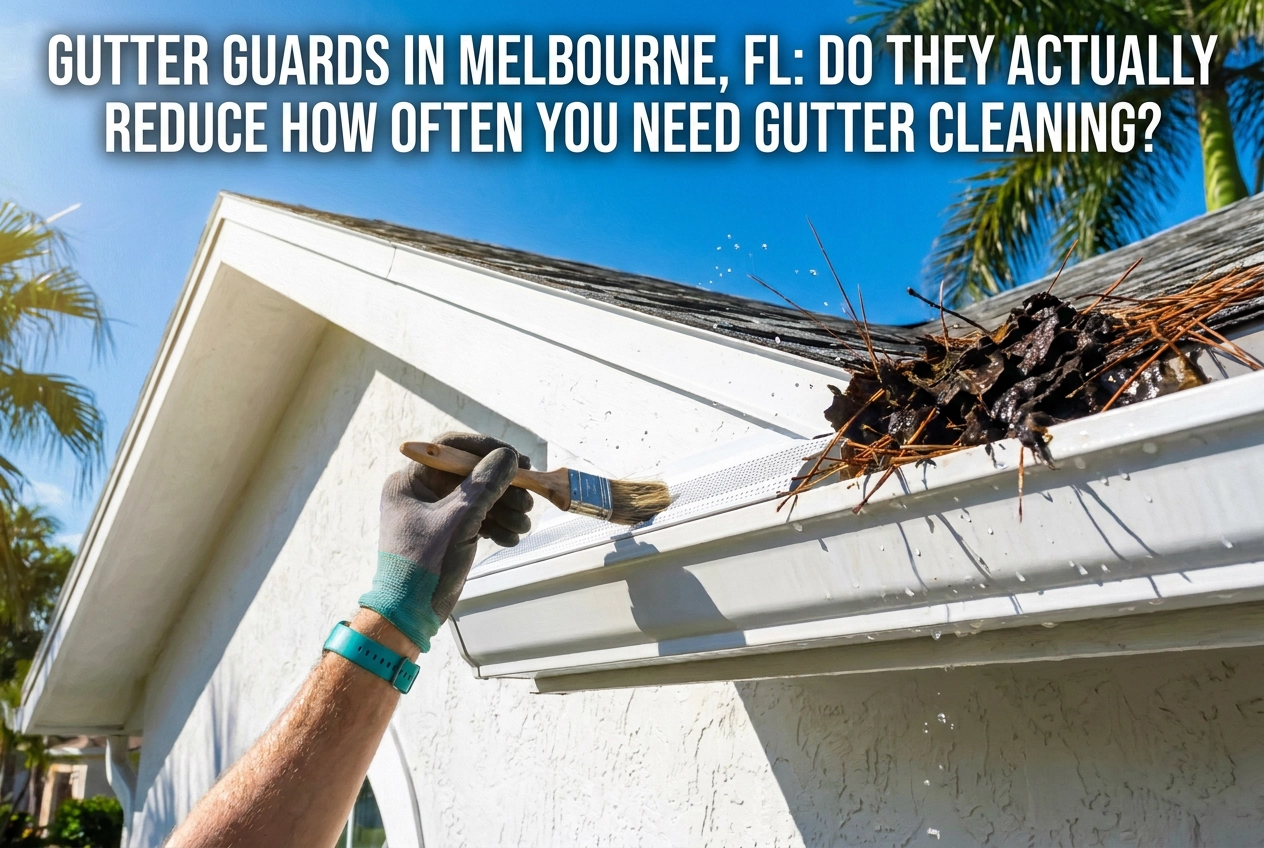
If you've ever stood on a ladder scooping handfuls of soggy leaves out of your gutters, the idea of a "maintenance-free" solution probably sounds like a dream. Gutter guard companies know this, and their marketing leans into it hard. But here in Melbourne, FL, those promises deserve a closer look before you spend the money.
The truth is, gutter guards can genuinely help Brevard County homeowners, but they rarely deliver the "never clean again" guarantee that the ads imply. Between the live oaks dropping litter year-round, pine needles threading through any mesh, and Spanish moss doing what Spanish moss does, our local environment is tough on even the best-rated products. Fine organic debris still sneaks through, biofilm still builds up, and your gutters still need attention.
This post gives you an honest, balanced look at what gutter guards actually do in a Florida subtropical climate. We'll cover how Melbourne's tree canopy affects performance, what the marketing language really means, which guard types hold up best here, and what a realistic maintenance schedule looks like when you factor in a professional gutter guards cleaning service. No hype, just what you actually need to know.
The 'Maintenance-Free' Promise vs. Brevard County Reality
Read the label closely on most gutter guard packaging and you'll find careful phrasing like "reduce likelihood of clogs" or "reduce maintenance", not "eliminate." That's intentional. It's a legal hedge, and most homeowners scroll right past it.
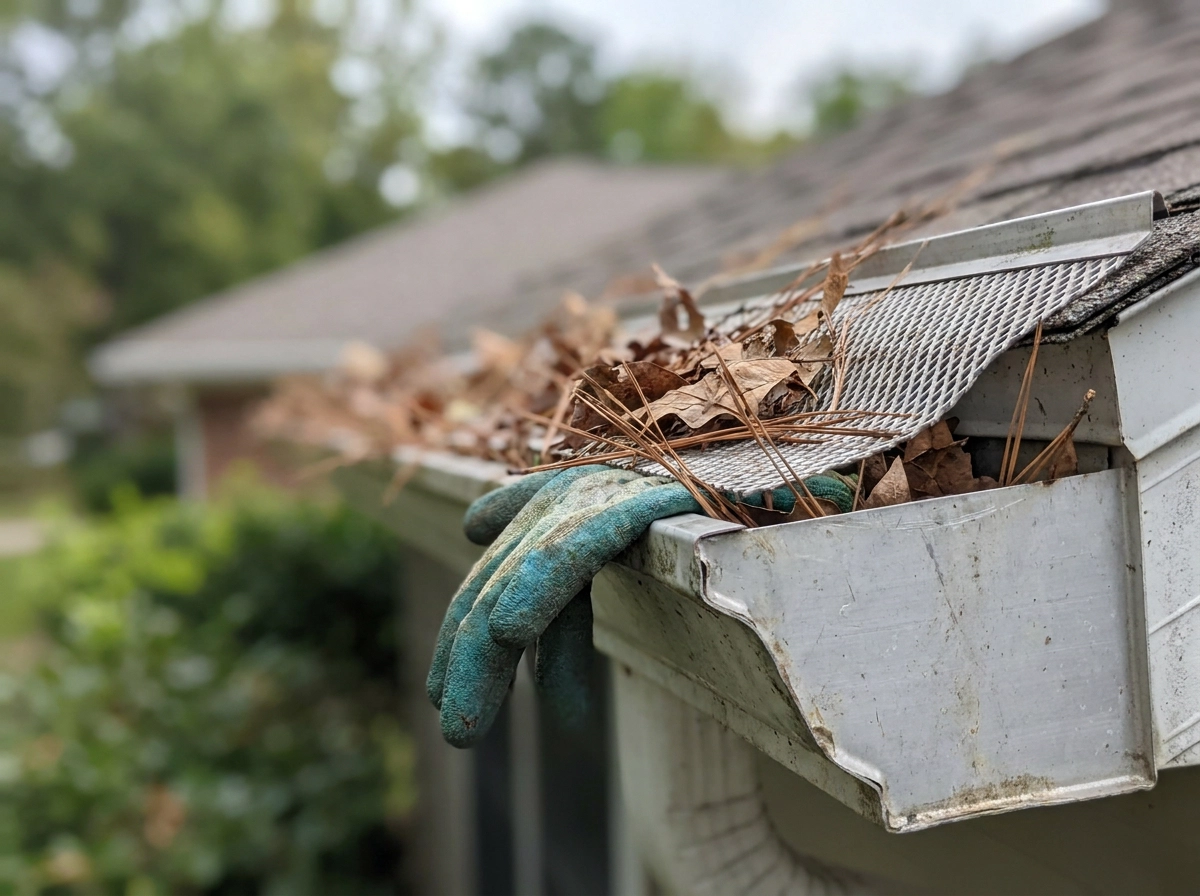
The problem is that language was written with northern, seasonal climates in mind, where leaves drop in October and gutters get one hard cleaning in November. Melbourne is a different situation entirely. Live oak trees make gutter buildup a year-round problem in Brevard, shedding small waxy leaves and samaras on a rolling cycle with no real off-season. Add pine needles, fragments of Spanish moss, pollen, and the biofilm that builds up in Florida's year-round humidity, and you have a debris profile that most guard systems simply weren't engineered to handle.
The real-world failure mode isn't dramatic. It's quiet. Fine organic matter, pollen, and decomposing material pass straight through mesh openings and settle at the bottom of the gutter channel. From the ground, everything looks fine. Inside the gutter, sediment is building up with every rain.
In Brevard County, guards extend the interval between professional cleanings, they don't replace those cleanings.
Why Melbourne's Trees Are the Real Variable
The "maintenance-free" pitch falls apart fast once you look at what's actually growing over Melbourne rooflines. The tree mix in Brevard County is genuinely different from what most guard systems were engineered around.
Live oaks are the dominant canopy tree across Melbourne and most older Brevard neighborhoods. Unlike deciduous trees up north that drop everything in October and go quiet, live oaks keep the debris cycle running year-round with no clean window for your gutters. Why Melbourne Homes Need Regular Gutter Cleaning breaks down what that means for your home's exterior.
Pine needles are a separate problem. They are narrow enough to slip through or wedge sideways into virtually any mesh opening. Once wet, they mat into a dense, felt-like layer that diverts water over the front edge of the gutter instead of into it.
Spanish moss is coastal Florida's wildcard. It breaks apart into fine fibrous strands that settle onto and inside guard surfaces, compact when moisture hits them, and require hands-on service to clear properly.
Micro-mesh guards can reduce oak leaf accumulation by up to 89%, which is a real improvement. But fine particulate, pollen, grit, and decomposing organic matter still reach the gutter floor. On the coast, salt air accelerates corrosion on both gutters and metal guard components, making regular inspection a structural necessity, not just a debris question. What's Actually Growing on Your Roof in Brevard County covers how that coastal environment affects exterior materials more broadly.
What the Data Actually Shows About Guard Performance
The anecdotal picture from Melbourne's rooftops lines up closely with the installation data.
An analysis of over 1,200 professional micro-mesh guard installations tracked from 2019 to 2025 found debris accumulation inside gutters dropped by 87 to 94% compared to unguarded systems. That is a meaningful improvement. It is also not zero.
For heavily canopied properties, the numbers are even more striking. Homes with 30% or more tree coverage, which describes a lot of Melbourne's older neighborhoods, saw pine needle blockage drop from roughly 3.2 cleaning cycles per year down to 0.4 cycles annually after micro-mesh installation. That is going from cleaning three-plus times a year to less than once. Most homeowners would call that a win.
Overflow incidents tell a similar story. 91% of guarded homes reported zero overflow over a three-year window. But that leaves 9% that still experienced overflow, and in Brevard County's storm season, a single overflow event can mean water against your foundation or into your fascia boards.
The detail that catches most homeowners off guard: oak and maple samaras, those helicopter seeds falling from local trees, penetrate standard mesh apertures at a 6 to 13% rate. Surface clearing is still required each season regardless of mesh quality.
The honest summary is that guards shift the schedule from "clean twice a year" to something closer to an annual inspection with cleaning as needed. If setting up a recurring maintenance plan for your Melbourne home is the goal, guards are a useful piece of that plan, not a replacement for it.
The Debris Guards Cannot Stop: Biofilm, Sediment, and Fine Organic Matter
Even with guards doing their job on larger debris, there's a whole category of buildup they simply cannot touch.
Biofilm is the first culprit. Florida's humidity creates ideal conditions for a slick layer of algae, bacteria, and decomposing organic matter to colonize the inside of your gutters and coat the surface of guards. It doesn't look like much, but it narrows the channel and slows water flow even when no visible leaves or twigs are present.
Then there's pollen. Brevard County sees significant pollen surges particularly during winter months, driven by alder, elm, and juniper. Pollen particles are far too fine for any mesh grade to catch. They wash down into the gutter, settle, and when the Florida rain-and-dry cycle repeats itself, that pollen bonds into a thin, dense sediment along the gutter floor.
Roof grit adds to it. Every rain event pulls granules off asphalt shingles and deposits them inside the gutter channel. No guard system filters particles that small. It accumulates quietly, season after season.
Here's what the marketing materials skip: clearing this fine-layer buildup adds up to $50 to $150 annually in hidden biofilm removal costs not captured in "maintenance-free" marketing claims.
And none of this is visible from the ground. You cannot flush it with a garden hose. As Seaton covers in more detail over at why gutter cleaning is a bigger deal in Florida than you might think, this is exactly why hands-on professional service remains necessary even after guards are installed.
Guard Types and How They Hold Up in Florida's Climate
Not all guards are created equal, and type matters once you factor in Florida's heat, humidity, and Brevard County's specific debris mix.
Micro-mesh guards are the strongest option for Melbourne homes. Tight mesh blocks leaves, samaras, and most debris while channeling water into the gutter. The catch: pollen and biofilm gradually seal the surface, so periodic cleaning is still required to keep water flowing through rather than over.
Reverse-curve and surface-tension guards rely on precise roof pitch. Water follows the curve in; debris falls away. That works on standardized rooflines. Melbourne's older ranch homes, split-levels, and Florida vernacular construction often have pitch angles that don't cooperate, causing water to sheet over the gutter edge during heavy rain instead of entering it.
Foam insert guards are a hard pass in Florida's climate. Porous foam traps moisture, invites mold, and creates ideal nesting conditions for small animals. Both problems develop out of sight for months before causing real damage. The biofilm and organic buildup risks common to Florida roofs apply even more aggressively inside a saturated foam core.
Screen and perforated-cover guards are the most affordable and least effective option. Pine needles wedge into screen openings; Spanish moss passes through with almost no resistance, leaving gutters nearly as vulnerable as having no guard at all.
Guard type changes how quickly debris accumulates, not whether it does. For a full breakdown, the bottom line on gutter cleaning tools is worth a read. Every guard type still needs periodic professional inspection; the only real question is how far apart those visits can be.
The ROI Reality Check for Melbourne Homeowners
So you've picked the right guard type for your roof. Now the real question: does the math actually work?
Professional-grade micro-mesh systems run $18 to $40 per linear foot installed. For example, a home with 150 linear feet of gutter, a common mid-size footprint, would face an upfront cost of roughly $2,700 to $6,000 before a single cleaning is factored in.
The industry-standard payback period is 7 to 9 years, assuming guards meaningfully reduce your cleaning frequency. That's a reasonable assumption for Brevard County homes. The problem is timing: many homeowners sell or move before a decade is up, which can mean absorbing the full installation cost without reaching the 7-to-9-year breakeven point.
The clearest candidates for a positive ROI are homeowners who plan to stay long-term and sit under heavy canopy, think dense live oaks or pine clusters close to the roofline. If you have minimal tree coverage or a move on the horizon, the numbers get harder to justify.
Here's what guards never change: professional gutter cleaning services are still part of the budget. Biannual cleaning typically runs $218 to $470 per visit. With guards installed, most Melbourne homes can realistically drop to one inspection-plus-clean per year, or every other year. That's genuine savings, just not the zero-maintenance outcome the marketing implies.
The financially sound way to think about it: guards are a maintenance interval extender, not a maintenance eliminator. Budget accordingly, and keep one annual professional cleaning on the calendar to make sure the system is actually working.
What a Realistic Maintenance Schedule Looks Like With Guards in Brevard County
So what does that actually look like on a calendar for a Melbourne homeowner with guards installed?
For most properties, plan on one professional gutter inspection and cleaning per year. Late fall is the best timing locally, after live oaks and Spanish moss have done their heaviest shedding for the season. That single annual visit handles what has accumulated inside the gutter channel throughout the year.
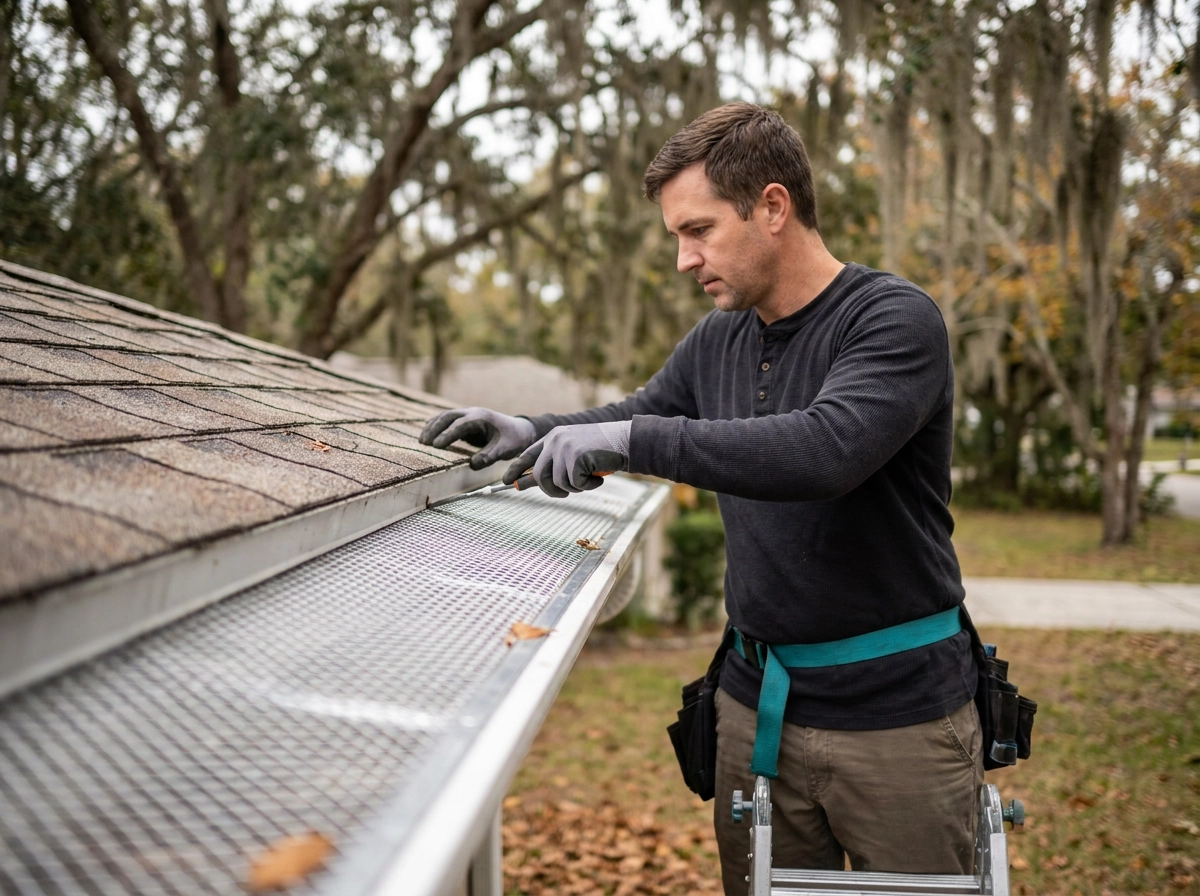
If your home sits under significant pine coverage or has large live oaks hanging over the roofline, one visit may not be enough. Needles and samaras pile up on top of the guard surface itself, and once that layer builds, water starts rolling off the edge instead of entering the gutter at all. Two service visits per year is a reasonable baseline for those properties, even with quality micro-mesh installed.
Brevard's storm season adds another layer. After a tropical system or a heavy squall line moves through, it is worth doing a quick visual check of your guard surfaces and downspout flow. National maintenance schedules rarely account for Brevard's above-average storm activity, so a post-storm visual check of guard surfaces and downspout flow is worth adding to your routine.
The honest reality is that no published schedule fits every property. Tree coverage, guard type, roof pitch, and proximity to the coast all change the math. A local gutter cleaning service near you can assess your specific situation and give you an interval that reflects your actual roof, not a national average.
Seaton services Melbourne homes with guards regularly and sees firsthand what collects inside. Guards or not, the gutters still need attention. Just less often.
So Should You Get Gutter Guards? The Honest Answer for Melbourne, FL
So knowing what your gutters are up against, here's a straightforward answer.
Guards make the most sense if you have mature live oaks or pine trees overhanging your roofline, you own a two-story home where getting on a ladder is a real safety concern, or your current goal is cutting professional cleanings from twice a year down to once.
They make less sense if you have minimal canopy, easy ground-level access, or a near-term move on the horizon.
The "never clean again" pitch is not accurate for Brevard County, full stop. Live oaks, pine needles, Spanish moss, and year-round pollen make sure of that. Any installer who tells you otherwise is not leveling with you.
The honest value proposition is this: quality micro-mesh guards, paired with one annual professional gutter cleaning service, give you a system that is genuinely easier to manage, lower risk, and lower maintenance over time. Not zero maintenance. Lower maintenance.
If you already have guards installed and you're wondering whether your gutters still need attention, the answer is almost certainly yes. Fine debris, biofilm, and sediment have been building up inside regardless. Booking a gutter guard cleaning service to find out what's actually in there is the right first step, not a sign that your guards failed.
The Bottom Line for Brevard County Homeowners
Here's the honest summary: gutter guards deliver on the frequency reduction promise for most Melbourne homes. The data backs that up. What they don't deliver is a permanent pass on professional maintenance, and in Brevard County specifically, that gap matters.
The practical approach is straightforward. Treat guards as an interval extender, not a replacement. Pair them with a consistent professional gutter cleaning service once a year, and your system stays functional without the twice-yearly scramble most unguarded homes deal with.
At Seatown Window and Wash, Seaton services Melbourne and Brevard County homes with guards installed and without. No corporate pricing structures, no upsell pressure, just transparent quotes from a local owner who knows what actually accumulates on Brevard rooflines after a wet summer or a windy October.
If you're unsure what service interval fits your property and tree coverage, that's exactly what a free quote conversation is for. Every home is different, and a quick assessment beats guessing based on national averages that weren't built around live oaks and Spanish moss.
Ready to find out where your gutters actually stand? Contact Seatown Window and Wash for a free quote today.
Conclusion
Your gutters are doing quiet, critical work every time it rains. Treat them accordingly.
If you want a straight answer about what your specific property needs, Seatown Window and Wash offers free quotes with zero pressure. Local knowledge, honest assessments, and service built around Brevard County realities. Reach out today and know exactly where you stand.