Picture this: you step outside and notice your home's exterior looking dull, streaky, and covered in green mould or black grime. It happens to the best of us, especially in Melbourne's unpredictable climate. But before you grab a pressure washer and blast away, there's a gentler, smarter option worth knowing about.
Soft wash house cleaning is a method that's growing in popularity among Melbourne homeowners, and for good reason. Unlike high-pressure washing, it uses low pressure combined with specialised cleaning solutions to safely remove dirt, mould, algae, and grime from your home's surfaces without causing damage.
In this guide, we'll walk you through exactly what soft wash house cleaning is, how it works, and why it might be the better choice for your Melbourne home. Whether you're a first-time homeowner or just exploring your exterior cleaning options, you'll come away with a clear understanding of the process and whether it's right for your situation. Let's break it all down in plain, simple terms so you can make a confident, informed decision.
What Is Soft Washing?
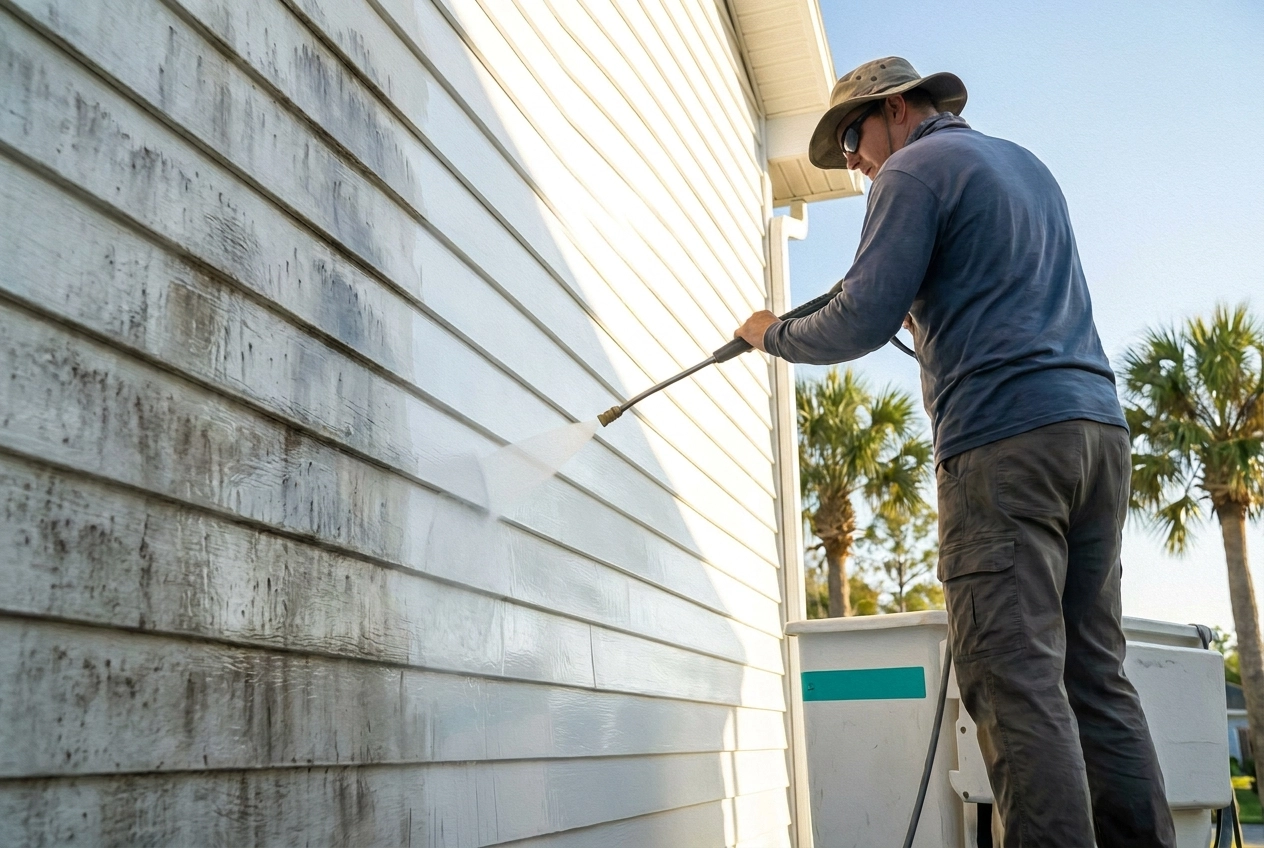
Soft washing is a low-pressure exterior cleaning method that combines water (typically under 500 PSI) with a biodegradable cleaning solution to safely remove mold, mildew, algae, lichen, and built-up dirt from the outside of your home. If you've ever noticed those dark streaks or fuzzy green patches on your siding or roof, that's exactly what soft washing is designed to tackle.
Here's what makes it different from standard pressure washing: instead of relying on brute mechanical force to blast surface staining away, soft washing lets the cleaning solution do the heavy lifting. Surfactants in the mix loosen and lift grime, while active biocidal ingredients neutralize algae, mold, and bacteria at the source. That distinction matters more than it might seem. Pressure washing can knock off visible staining temporarily, but it leaves the underlying organisms alive in the surface. Soft washing actually kills the growth, which is why results tend to last significantly longer before regrowth appears.
The method is also specifically engineered for surfaces that high-pressure water would damage. Vinyl siding, stucco, painted wood, roofing shingles, and window screens are all vulnerable to cracking, stripping, or paint loss under high-pressure spray. Soft washing eliminates that risk entirely. In fact, most siding and roofing manufacturers recommend low-pressure cleaning methods to keep material warranties valid, since high-pressure washing can void coverage by causing physical damage.
You can learn more about what makes soft washing biodegradable and why eco-friendly solutions are standard in professional applications. For Florida homeowners especially, where humidity and salt air accelerate organic growth year-round, soft washing is not just a preference; it is genuinely the smarter, safer approach to keeping your home's exterior clean and protected.
Soft Washing vs. Pressure Washing: What Is the Difference?
Now that you know what soft washing is, it helps to understand how it compares to pressure washing, because the two methods are genuinely different tools built for different jobs.
Pressure washing uses high-pressure water, typically ranging from 1,500 to 4,000+ PSI, to physically blast contaminants off hard, durable surfaces. Concrete driveways, brick pavers, pool decks, sidewalks, and retaining walls can handle that kind of force. On those surfaces, pressure washing is absolutely the right call and delivers excellent results.
Soft washing operates at under 500 PSI, sometimes as low as 40 PSI, which is gentler than a standard garden hose. Instead of relying on mechanical force, soft washing lets the cleaning solution do the heavy lifting. That chemistry penetrates and kills mold, mildew, and algae at the root rather than just blasting the surface clean. According to Seattle Pump's breakdown of soft wash vs. pressure wash, that distinction matters a lot when it comes to choosing the right method for your home's exterior.
The problem happens when someone applies high pressure to surfaces that cannot handle it. Pressure washing vinyl siding, stucco, painted wood, or window screens causes real damage: stripped paint, cracked stucco, forced water intrusion behind siding panels, broken screens, and even voided manufacturer warranties. Those repairs often cost far more than a professional soft wash would have in the first place.
A professional exterior cleaning company will walk your property, assess each surface, and recommend the right method for each area. Most homes actually need both. Hard surfaces below get pressure washed; siding, rooflines, and screens above get soft washed. Per JRacenstein's comparison of pressure washing vs. soft washing, applying both methods correctly is what separates a professional service from a one-size-fits-all approach.
Understanding this difference before you hire anyone puts you in a much better position as a homeowner.
Why Florida Homes Need Soft Washing More Than Most
If you live in Melbourne or anywhere else in Brevard County, your home is working against the clock in ways that homeowners in cooler, drier states simply don't deal with. Florida's combination of heat, humidity, and near-constant moisture creates conditions where algae, mold, mildew, and lichen don't just show up seasonally; they grow year-round. The warm temperatures never really drop low enough to slow biological growth, and the humidity keeps exterior surfaces damp almost continuously. That cycle repeats week after week, which is why a home that looked clean six months ago can look noticeably green or streaked today.
Brevard County adds another layer to this problem. Living near the Atlantic coast means your home is also exposed to salt air, which slowly corrodes siding, painted surfaces, and window frames while leaving behind a fine film that organic growth clings to. Coastal neighborhoods in Melbourne, Cocoa Beach, and Titusville see this accelerated wear more than most. The salt doesn't just cause cosmetic issues; it weakens surface materials over time and makes it easier for biological growth to take hold and spread.
Here's something most homeowners don't realize: those dark streaks running down your siding or roof aren't just dirt. They're often a living organism called Gloeocapsa magma, a type of cyanobacteria that's extremely common throughout Brevard County. Florida homes deal with this kind of buildup far more frequently than homeowners in other regions, and it won't go away on its own. Ignoring it isn't just a visual problem either. Mold and algae trap moisture directly against your stucco, paint, wood, and roofing materials, and that retained moisture accelerates deterioration from the inside out. What starts as a cosmetic issue can become a premature paint failure or roofing damage if left untreated long enough.
This is exactly why exterior cleaning in warm, humid climates is a recurring maintenance need rather than a one-and-done project. The global house washing services market was valued at $18.4 billion in 2025 and is projected to reach $31.2 billion by 2033, and a significant share of that growth is driven by homeowners in regions just like ours, where skipping exterior maintenance simply isn't a realistic option.
Which Surfaces on Your Home Benefit from Soft Washing?
Not every surface on your home responds the same way to cleaning, and that is exactly why soft washing exists as a separate method. Here is a breakdown of the specific surfaces where soft washing makes the biggest difference, especially for homes here in Melbourne and Brevard County.
Vinyl Siding
Vinyl siding covers a huge percentage of homes throughout the Melbourne area, and it happens to be one of the surfaces most affected by algae and mildew in Florida's climate. The problem with using high pressure on vinyl is that the force can warp panels, crack seams, and drive moisture behind the siding where it causes hidden damage over time. Soft washing cleans at roughly garden-hose pressure, letting the biodegradable solution do the actual work of killing the organic growth at the root rather than just blasting it off the surface temporarily.
Stucco
Stucco is everywhere in Brevard County, and it is honestly one of the trickiest surfaces to clean safely. High-pressure water does not just clean stucco; it forces water into tiny surface pores and behind the material, which leads to moisture intrusion and structural damage that can be expensive to repair. Soft washing is widely recognized as the safest method for stucco homes, using low pressure and the right chemical mix to lift staining and biological growth without putting your exterior at risk.
Painted Wood Trim and Fascia Boards
Wood trim, fascia boards, and painted surfaces are particularly vulnerable to pressure washing damage. High pressure weakens paint adhesion, causes peeling, and strips protective finishes, which leads directly to premature repainting costs. Soft washing clears away the mold and mildew growing beneath the paint film while keeping the finish intact, protecting both the appearance and the longevity of those surfaces.
Window Screens
Screen mesh is fragile, and pressure washing can tear, stretch, or completely deform it. As part of a full exterior cleaning, soft washing cleans screens thoroughly and gently without causing any physical damage to the mesh material. It is a small detail that makes a noticeable difference in the finished result.
Rooflines and Soffits
Rooflines and soffits tend to get skipped during exterior cleaning, but ignoring them creates a real problem. Organic growth builds up on overhangs and soffits, and every time it rains, that growth washes downward directly onto your freshly cleaned siding below. Including these areas as part of a whole-home soft wash service stops that cycle from repeating and keeps the entire exterior looking clean longer between visits.
What Is in the Soft Wash Solution and Is It Safe?
A professional soft wash solution is built on two core ingredients: sodium hypochlorite and biodegradable surfactants. Sodium hypochlorite is essentially a diluted bleach compound, the same active ingredient used to sanitize drinking water, just mixed at controlled concentrations for exterior cleaning. The surfactants work alongside it by helping the solution cling to vertical surfaces like siding and stucco so the chemistry has time to penetrate and kill organic growth at the root before the rinse cycle washes everything away. Once rinsed, sodium hypochlorite breaks down into oxygen, salt, and water, leaving no harmful residue behind.
One thing that separates a trained professional from someone who just bought a pump sprayer is knowing how to adjust those concentrations by surface. Roof shingles, for example, require a different dilution than vinyl siding or painted wood. Using the wrong strength can damage a surface or simply not clean it properly. That calibration is a technical skill, and it is exactly why professional application matters more than the solution itself.
The biodegradable nature of these surfactants also lines up with a broader shift happening across the industry. Eco-friendly service adoption is one of the named drivers behind the house washing market's projected growth through 2033, and soft washing with sodium hypochlorite actually uses up to 70% less water than traditional pressure washing while delivering longer-lasting results.
As for your plants and landscaping, a professional operator pre-wets surrounding vegetation before any solution is applied and rinses thoroughly after the job is done. That is not an upgrade or an add-on; it is standard procedure.
At Seatown Window and Wash, we are upfront about what we use, how we use it, and what we do to protect your property. That transparency is not just good practice. It is how you know the company showing up actually knows what they are doing. A mixing ratio guide for sodium hypochlorite confirms that proper formulation is a technical skill, not a guessing game, and that is exactly how we treat it.
How Often Should Melbourne, FL Homes Be Soft Washed?
For most homes in Melbourne and the surrounding Brevard County area, a full exterior soft wash every 12 to 18 months is the practical maintenance window to aim for. That said, not every home sits at the same point on that range. If your property is close to the coast, sits under a heavy tree canopy, or has north-facing walls that stay shaded and damp throughout the day, you are likely looking at closer to the 12-month end of that cycle. Florida's salt air, persistent humidity, and organic debris create conditions where algae and mildew can take hold faster than most homeowners expect.
Your home will usually tell you when it is overdue before you think to check the calendar. Visible green or dark streaking on siding, a chalky or dingy appearance on stucco, black streaks running down from the roofline, and grime building up around window frames and screens are all signs that organic growth has already moved past the surface and started settling in. That black streaking along the roofline is especially common here on the Space Coast. It is typically caused by a type of algae that feeds on the limestone in asphalt shingles, and it does not go away on its own.
Catching these issues early is always the smarter financial move. Organic growth that sits long enough can begin to compromise the surfaces beneath it, and remediation at that stage costs significantly more than a routine soft wash would have. This is one of the core reasons that recurring maintenance plans make so much sense for Brevard County homeowners. Staying on a consistent schedule keeps growth from ever reaching the damage stage in the first place.
As for timing, two windows tend to work well locally. Spring, before peak humidity season kicks in, gives you a clean slate heading into the months when growth accelerates fastest. Fall, after summer storm activity settles down, is equally smart because it clears off everything that built up through the rainy season. Either way, the goal is simple: your home should never get to the point where it looks neglected. Curb appeal, property value, and the everyday satisfaction of pulling into a clean driveway are all real benefits that come with staying ahead of it rather than catching up to it.
Why Melbourne Homeowners Choose Seatown Window and Wash
Seatown Window and Wash is a locally owned, owner-operated exterior cleaning company founded right here in Melbourne by Seaton, a 19-year-old entrepreneur who built the business from the ground up. This was not a franchise purchase or a corporate expansion into Brevard County. Seaton started with a genuine commitment to doing the job right, showing up professionally, and treating every home with the same care he would want for his own.
That personal accountability makes a real difference. Every job Seaton takes on is handled with professional-grade soft washing equipment, properly diluted cleaning solutions, and a detail-oriented process that does not cut corners to save time. When the owner is the one on-site doing the work, the standard stays high because his name and reputation are directly on the line with every single visit. That kind of ownership is something larger, franchise-based operators structurally cannot replicate.
Seatown is licensed and insured, and pricing is straightforward. You will get a clear estimate upfront, no surprise fees when the job is done, and no communication gaps that leave you wondering what is happening. In a market where homeowners in 2025 grew noticeably more selective and less tolerant of slow responses and vague quotes, Seatown was built specifically to answer that expectation.
Services include house soft washing, exterior window cleaning, pressure washing for hard surfaces, gutter cleaning, screen cleaning, and additional exterior maintenance needs across Brevard County. If you are ready to see what a locally owned, detail-focused crew can do for your home, reach out today for a free quote.
Ready for a Cleaner Home? Here Is Your Next Step
Soft washing is not a premium add-on for Melbourne homeowners who want a nicer-looking driveway. It is straightforward preventive maintenance that protects your siding, stucco, paint, and roofing from the kind of accelerated deterioration that Florida's humidity and heat make almost unavoidable. Waiting until damage is visible usually means the damage is already done.
The right time to schedule is before you see the problem, not after. And the right provider is one who is local, gives you a straight price upfront, and stands behind the results.
Seatown Window and Wash offers free quotes for soft washing and full exterior cleaning throughout Brevard County. Just reach out, share some details about your home, and you will get a clear, honest price with no pressure attached. Whether you need a one-time clean before listing your home, a seasonal refresh after rainy season, or a recurring maintenance plan to stay ahead of Florida's growth cycles, the process starts with one conversation.
Contact Seatown Window and Wash today to schedule your free quote and find out what a professionally soft washed home actually looks like.
Conclusion
Soft wash house cleaning offers Melbourne homeowners a safer, smarter alternative to traditional pressure washing. It effectively removes mould, algae, and grime using low pressure and specialised solutions, protecting your home's surfaces in the process. Melbourne's unpredictable climate makes regular exterior cleaning essential, and soft washing delivers long-lasting results without the risk of damage. Whether you have render, weatherboard, or roof tiles, this method suits a wide range of surfaces and budgets.
Your home's exterior deserves proper care, not a quick fix that causes more harm than good. If you've noticed green patches, black streaks, or a general dullness creeping across your facade, now is the perfect time to act. Reach out to a trusted Melbourne soft wash professional today and give your home the refresh it truly deserves.