
You know that moment when you're standing in your yard, looking at your house, and everything seems fine? The gutters are up there, the roof looks okay from this angle, and life goes on. But here's the thing: the view from the ground tells you almost nothing about what's actually happening up top. That's where a gutter cleaning visit becomes more than just a chore. When a cleaner climbs the ladder, they see things you never will from the driveway: shingle granules collecting in the debris, rust streaks running down the outside, or water overflowing at just one corner. These aren't random annoyances. They're clues. In this post, we'll walk through what a full gutter tells you that an empty yard doesn't, what shingle granules and rust streaks might mean, why overflow at one corner usually points to a blockage, and how sagging runs and matted debris signal weight and water issues. We'll also explain why the view from the ladder beats the view from the yard, why we send notes after a clean, and what all this looks like on Brevard County homes. Seatown Window & Wash is here to help you catch small problems before they become big ones.
What a Full Gutter Tells You That an Empty Yard Doesn't
From the ground, a gutter packed with oak leaves looks exactly like one packed with shingle granules, rust flakes, or a hanger that has lost its grip. Both just look full. The difference is in what the debris actually is, and that is the part worth paying attention to.
Everything in your gutter came off the house somewhere. Granules wash down from the shingles above, rust flakes off the hangers, and sand and grit blow in and settle. Where it came from is the interesting part.
A cleaning is often the only time each season that someone stands at the roof edge with both hands inside the run, seeing what the debris actually is instead of only how much of it there is. That is also why a professional gutter cleaning visit tends to catch signs your gutters are overdue for a cleaning well before they turn into repairs.
To keep this honest: what follows is what we commonly see on Brevard homes, not a certified roof inspection and not a code check. Anything that looks concerning gets flagged so you can call a licensed roofing contractor.
This piece walks through the handful of things a gutter cleaning visit looks for at roof level, and what each one may suggest about the roof, the hardware, and the fascia behind it.
Shingle Granules in the Debris: What They May Say About Roof Wear
Granules are usually the first thing that catches our eye. Asphalt shingles are surfaced with ceramic granules, and those granules shed over time. They land on the roof, wash into the gutter, and settle in low spots as dark, sandy grit.
A light scatter is normal on an aging roof. What gets our attention is a heavy, gritty pile concentrated under one section of the roof instead of spread evenly along the whole run. Granules are the shingle's first layer of protection against sun and rain. An area that has lost them is often where surface wear shows up first, long before anything looks wrong from the yard.
We cannot tell you your roof is failing, and we will not pretend to. We can tell you that one recent gutter cleaning visit pulled a shovelful of black grit from a single valley-side run, and we can point to where above the house it likely came from. That gives you something concrete to take to a roofer if you want a licensed opinion.
One more clue from the same visit: loose granules paired with shingle edges that appear curled or lifted, if shingle edges also appear curled or lifted when we sight along the roofline, that's a combination worth mentioning to a roofer. Either finding alone is not a crisis. Together, they are worth asking about.
Rust Streaks Down the Outside: Hangers, Screws, and Hardware
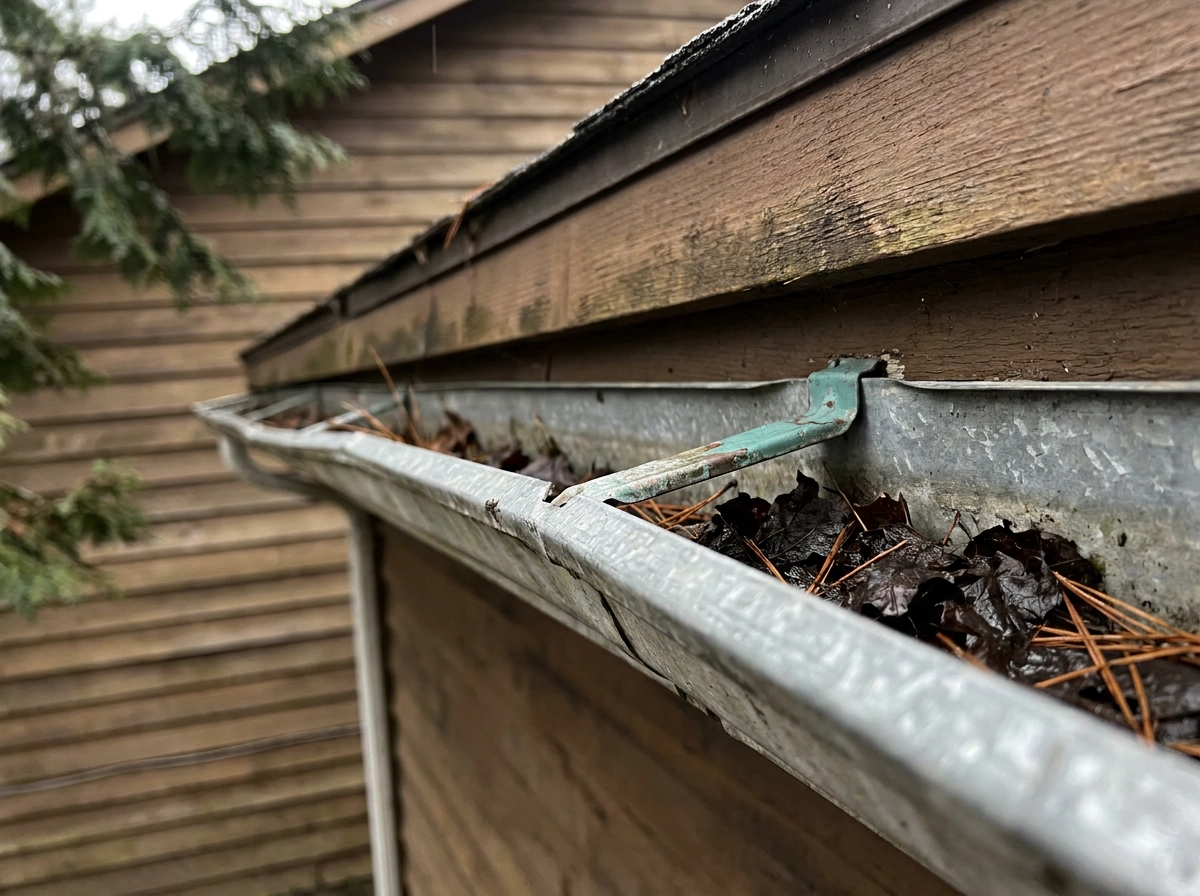
If the grit is the roof talking, rust is the hardware talking. Look for rust-colored stains running down the face of the gutter, down white siding, or down the fascia board just below the gutter line. From inside the run, those streaks often start at the fasteners and hangers holding the gutter to the fascia: fasteners and hardware that have stayed wet across many seasons, in our experience. In our experience, a hanger corroded enough to lose its grip lets the gutter pull forward or droop, which changes the slope. Once slope is off, the gutter can stop draining properly even when it is completely clear. Sometimes the stain is not the gutter metal at all. It comes from the fascia board and hardware behind it, which is why we look behind the gutter and at the wood it is mounted to, not just the metal. Streaks near a seam or corner can point to old sealant that has let go. Catching that in spring beats discovering it during a summer downpour. It is also one more reason putting off gutter cleaning too long tends to get expensive. A single corner that floods every storm is a different clue.
Overflow at One Corner: Why We Check for a Blockage First
A corner that overflows every storm is a more obvious version of the same story: water finding a way past hardware that is no longer doing its job. What you will see is water sheeting off one end of a run during a downpour, or a wet stripe on the wall under one corner while the rest of that same run stays dry.
When the overflow is isolated like that, in our experience it most often traces to a localized blockage: a pile of leaves sitting at the outlet, a drop into the downspout that has clogged, or a gutter screen that has matted over instead of letting water through. In our experience, undersized gutters do exist, but they tend to fail along the entire run, not at a single corner. If the problem shows up in one place, the cause is usually in one place too.
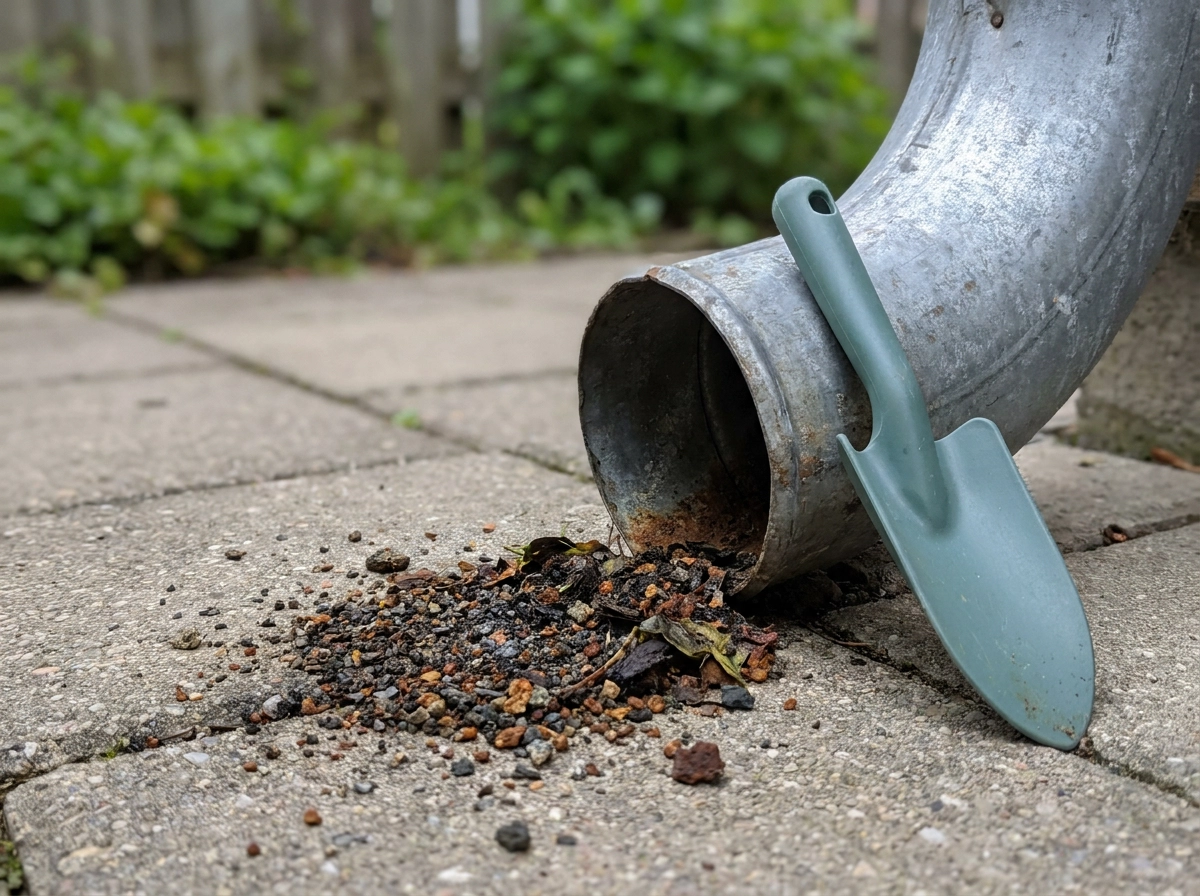
That is why we check the outlet and the first few feet of the run. Leaves, pine needles, and shingle grit dam up there and push water backward over the lip. Left alone, that corner stays soaked, stains siding, and can work its way into the wall. Clearing a blockage is a quick fix. Repairing what the water found is not.
Sagging Runs and Matted Debris: Weight, Water, and Fascia
A sagging run is a different kind of warning. You might see a gutter dipping in the middle, holding water days after a storm, or pulling away from the fascia board. In our experience, wet debris is heavy. A run packed with matted pine needles, leaves, and grit can weigh far more than the hangers were ever asked to hold. Those hangers are spaced for an empty gutter, not a soaked plug. Standing water is the other half of the problem. Water that never drains keeps the gutter and the fascia behind it wet, and that is, in our experience, how rust and wood rot can get their start. Matted debris also compacts into a plug instead of flowing, so the gutter can stop working long before it overflows where you can see it. We point out sag lines and separations because these are the findings that turn into a re-hang or a fascia repair if they sit another season. On a gutter cleaning visit, that is exactly the kind of thing we note while the run is open.
Why the View From the Ladder Beats the View From the Yard
Past the sag lines, there's a bigger reason we like getting up there. With a gutter cleaning visit, you are not just paying for a clean gutter. You are paying for what a trained eye notices while the run is open and empty.
From the ladder at the roof edge, you get a view that is simply not available from the yard: inside the run, the outlet, the fascia behind the gutter, and the lowest courses of shingles above it, all at once.
That up-close vantage lets us note everything covered in the sections above and photograph anything worth remembering. Much like Why Exterior-Only Window Cleaning Makes Sense for Most Homeowners, the real value is in what a pro sees up close. It also keeps you off a ladder in Florida heat with wet, slippery conditions underfoot, a job worth handing off.
Why We Send You Notes After the Clean
After a gutter cleaning visit, you get a short note: what we pulled out of each run, what we noticed while it was open, and photos when a picture explains it faster than a paragraph. Plain language, no jargon. That note is not a professional roof inspection, we are exterior cleaners and not roofing contractors, but it is a straight account of what we observed.
That said, some things we flag every time. A fascia board that shows signs of softness or deterioration. A section of shingles that has clearly given up its granules. When we see either, we tell you straight and suggest you get a licensed roofer out to take a look.
Keep those notes. If a roofer visits next year, knowing the same gutter has been shedding grit for two seasons is real context instead of a guess. It works a lot like the most overlooked part of exterior home cleaning: the payoff shows up later, not on the day of service.
We would rather be the company that tells you something early than the one that quietly cleans around a problem and says nothing.
What This Looks Like on Brevard County Homes
That reporting matters even more here, because Brevard County is hard on roofs and gutters. Anyone who has lived in Brevard knows the combination: heavy summer rain, year-round humidity, and hurricane season every year. That combination shows up in what comes out of the run: grit, rust flakes, and debris that has been wet more often than it has been dry. The same humidity that keeps gutters damp means Florida's climate makes exterior mold a year-round problem in Brevard County, and gutters that stay clogged only make it worse.
In our time cleaning homes around Melbourne and the beachside, we regularly see older housing stock with aged shingles, original hangers, and gutters that have carried Florida debris for decades. We find oak leaves, pine needles, and windblown sand collect differently street by street, so how often a home needs service depends on tree cover, roof pitch, and how much leaf drop lands up top. We adjust the schedule to the property, not to a fixed rule.
Local and owner-operated matters here, too. Seatown Window & Wash is run by Seaton, a 19-year-old local owner, and the same person who cleans your gutters is the one who notices what has changed since last time. Timing counts as well. Clearing the gutters before the rainy season is when the diagnostic value pays off most, because a blocked run and a wet season are a bad combination.
How to Book a Gutter Cleaning in Melbourne and Across Brevard
If any of those Brevard-specific warning signs sound familiar, the simplest next step is a gutter cleaning visit where you ask for the findings, not just the clean-out. Have them photograph anything unusual and keep those photos. A cheap record this year gives you real context next year, whether you are talking to a roofer, an insurer, or just budgeting.
Anything structural, like soft fascia, lifted shingles, or a run pulling away from the house, deserves a licensed roofing contractor's eyes. Watching it for another season is not a plan.
Seatown Window & Wash cleans gutters for homeowners across Melbourne, Brevard County and the surrounding areas, reach out for a quote. If you would rather not think about it again, recurring maintenance plans keep the gutters clear and keep someone checking the roof edge on a schedule. That is the whole point: turning a chore into early warning.
Conclusion
Do not wait for the wet season to expose a blocked run. Seatown Window & Wash is local, owner-operated, with recurring maintenance plans available across Melbourne and Brevard County. Book a gutter cleaning visit, ask for the findings, and turn a chore into early warning.